How to dye pink naturally?
Published – Updated
Author : Céline PHILIPPE, Founder of Teinture Sauvage & Artisan in Natural Dyeing
In natural dyeing, avocado is one of the few plants that doesn’t need any mordant to bind the fiber.
Unlike dyeing with turmeric, but like onions, avocados are more resistant to light and washing.
I’d like to share my experience with you on a few linen swatches. Wool, another natural fiber, also responds very well to this plant dye.
You can also watch this presentation on video (in french).
My way is just one of many. The idea is to give you the necessary steps and ingredients. The field of possibilities is wide in botanical color, and that’s what makes it so exciting. I never look for a particular color. I receive what the plant can give me.
1. The color of avocado dyeing varies according to several parameters
The quantity of avocados: The quantity is calculated according to the weight of the fiber to be dyed: in my experiment I used avocado skins and stones (pits) at 100% of the fiber weight. As the stones are rich in dye, we can go down to 50%. So for 100g of fabric, I used 100g of avocado skins.
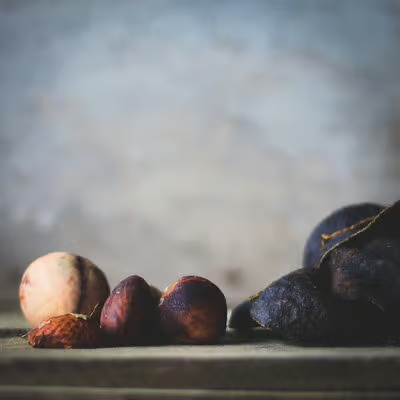
You can use skin and stones in the same bath for redder tones, or separately. The stones alone are pinkish in color, while the skins are more orange.
Avocado quality: Choosing avocados that are in season and grown organically and locally is better for nature. The darker the skin with red highlights, the richer the coloring.
Water quality: with hard water, tones will tend towards pink-red-brown, with more acidic or softer water, tones will be more orangey, salmon-like.
Cooking times also influence color, as does the phenomenon of oxidation, a particularity of avocado dye. Once out of the bath, the color of your fiber exposed to the air will strengthen.
The quality of the fiber to be dyed: avocado gives beautiful shades on botanical fibers and silk.
2. Materials required for avocado dyeing
- A stainless steel, enamelled iron or aluminium saucepan or stewpot
- Strainer and cloth cheesecloth for filtering
- An iron sponge or steel wool to recycle
- A jar
- Vinegar, bicarbonate of soda, washed and dried avocado skins and pits, then cut into small pieces.
- Squares of fabric or yarn in natural fibers, cotton, linen, hemp, silk, wool…
To learn more about the equipment needed for natural dyeing.
3. The different steps of avocado dyeing
3.1. First step : the decoction
- Place the pits and crushed skins in a saucepan. Pour water over it.
The colors will lean toward pink, red, and brown if the water used is somewhat basic and chalky (pH of about 8).
The tones will be more salmon or orange when the water is softer or more acidic (pH about 6). - After turning on the heat, progressively increase the temperature to a simmer (185–195°F/85–90°C).
- To achieve the desired shade, adjust the decoction’s pH:
- more alkaline with baking soda to get a pH of about 8, or
- more acidic with lemon juice for a pH of about 6.
- Keep at a simmer for 30 to 60 minutes, depending on the quantity of plant.
If evaporation takes place, add water in order to keep the plant fully immersed. - Switch off the heat. After cooling, strain the mixture using cheesecloth. Set aside the liquid dye.
- You can repeat the process and make a second decoction using the plant material recovered through the cheesecloth for a higher colorant concentration.
Add this second dye decoction to the first. - Leave the resulting decoction to stand for 12 to 24 hours.
The shades become uniform and consistent as the juice matures.
3.2. Second step: the dyeing
- Pour the dye liquid into a stockpot large enough to allow fibers to spread out.
- Add water to achieve a ration of approximately 1:20 (1 quantity of decoction for 20 quantities of water).
As previously mentioned, check the bath’s pH and adjust its level according to the intended color. - Add the pre-soaked and wrung-out fibers.
Make sure that they are fully submerged in the bath. - Turn on the heat and gradually raise the temperature to a simmer (185–195°F/85–90°C).
Maintain this temperature for approximately one hour.
Stir gently and frequently (every ten minutes or so).
To avoid oxidation, make sure the fibers are completely immersed throughout cooking; otherwise, marbling may occur. - Turn off the heat and allow the dye bath to cool.
For silk, the dye bath can be prepared in cold or even lukewarm water, and the fibers should be soaked for 12 hours with frequent stirring. - Once the bath has cooled, take out the fibers and wring them dry.
Keep out of direct sunlight to dry. - Lastly, wash using the standard natural dyeing precautions.
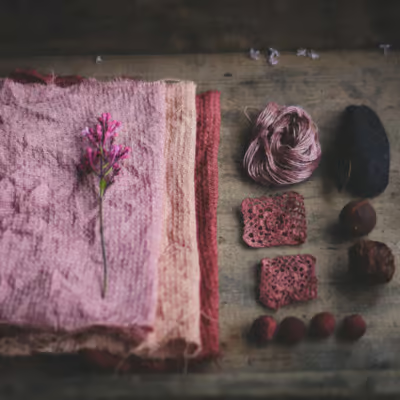
4. The colors obtained
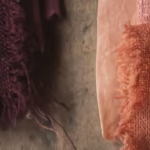
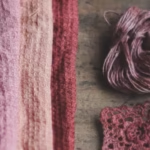
The shades obtained vary between red and beige depending on whether you use :
- stones alone,
- skins alone,
- both together.
These purplish-pink colors can also be obtained with rudbeckia flowers.
5. Turning the color
For rosier tones: add a good tablespoon of sodium bicarbonate to half a liter of lukewarm water. Soak for at least 5 minutes, keeping an eye on the color, taking it out when you like the shade.
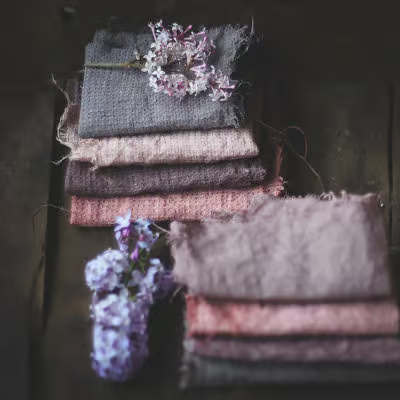
For purplish-gray shades only possible on plant fibers (avoid wool and silk, as they may damage the fiber): soak the dyed fabric in a solution of iron acetate (you can find the recipe for iron acetate here). Shades will change according to the soaking time and iron concentration of your solution.
To obtain a beautiful violet, it is possible to dye with phytolacca.
You can also watch this avocado dyeing recipe on video (in french).
What part of the avocado is used to dye fabrics and yarns?
Both skins and stones or pits are used for dyeing with avocado.
What is the recommended quantity of Avocado to dye fabrics?
To dye with dry skins of avocado, it is recommended to use 100 %-200% of the weight of fibers. And 50%-100% to dye with the stones.
What colors does avocado dye produce?
Avocado dye produces shades of salmon, pink and purple. The color depends on the pH of the water you use.
Which fibers can be dyed with avocado?
All types of natural fibers (animal or cellulose/plant based fibers) can be dyed with avocado. But cellulose/plant fibers offer very pretty shades of pink.
Does avocado dye need mordanting?
No you don’t need to mordant the fiber when you dye with avocado.
Does avocado dyeing last?
Yes, Avocado dye is resistant to washing and light.